
Sirāt (2025)
Danse Macabre

There is no tea on Mondays.
On Mondays there is nothing but the cold hard truth that the weekend has passed and five days are between you and the next one.
If five days seems long, ruminate on the 20 days currently between you and the televised 98th Academy Awards1.
Usually, I am a hard core “Oscar Grouch”. My happiest Oscar night memory of recent times was the year I skipped watching the ceremony to catch a late night screening of Spider Man: No Way Home.
But this year, the Oscar nominations are more interesting than usual. Especially categories like best Best International Feature Film.
Two of the five BIFF nominees, Secret Agent and Sentimental Value are also nominated for Best Picture. A third, It Was Just an Accident, totally should of been. As for the other two nominees, I have heard nothing but praise for The Voice of Hind Rajab.
I watched Sirāt yesterday.
I’m still processing how I feel about it.
Short answer: It’s good
Slightly longer answer: I thought Sirāt was going to be a surreal, experimental, mood-piece sort of movie.
It isn’t.
Also, I was totally unprepared for how disturbing it would be.
Sirāt is about a middle-aged man from Spain named Luis (Sergi López) searching for his missing teenage daughter, Mar.
Mar was last seen at a rave held in a remote part of Morocco. Not any kind of town or village, somewhere deep in the Sahara between dunes and mountains, far from running water, electricity or any sort of infrastructure.
When Luis arrives, the rave is still in progress. He immediately starts wandering the crowd of drug addled dancers holding up a polaroid of his daughter, asking anyone who will listen if they’ve seen her.
Luis is distraught and obviously has not thought his plan through. He has driven into the desert in a car designed only for paved roads. He’s brought along his very young son, Esteban (Bruno Núñez Arjona) and their dog, Pipa. He hasn’t brought much food, water or petrol.
No one Luis talks to recognizes Mar’s picture. The closest thing he gets to a helpful response is “Maybe she’s coming to the next rave”
Luis asks, “When is that?” and is told,
“Right after this one.”
That turns out to be pretty soon, because minutes later the Moroccan army arrive, shut off the music and tell everyone they have to leave. There’s considerable resistance from the ravers but the army ultimately gets their way and soon everyone is back in their vehicles and part of a convoy to the nearest airport.
Except for two RVs who make a break for it into the open desert and Luis who makes the split second decision follow them.
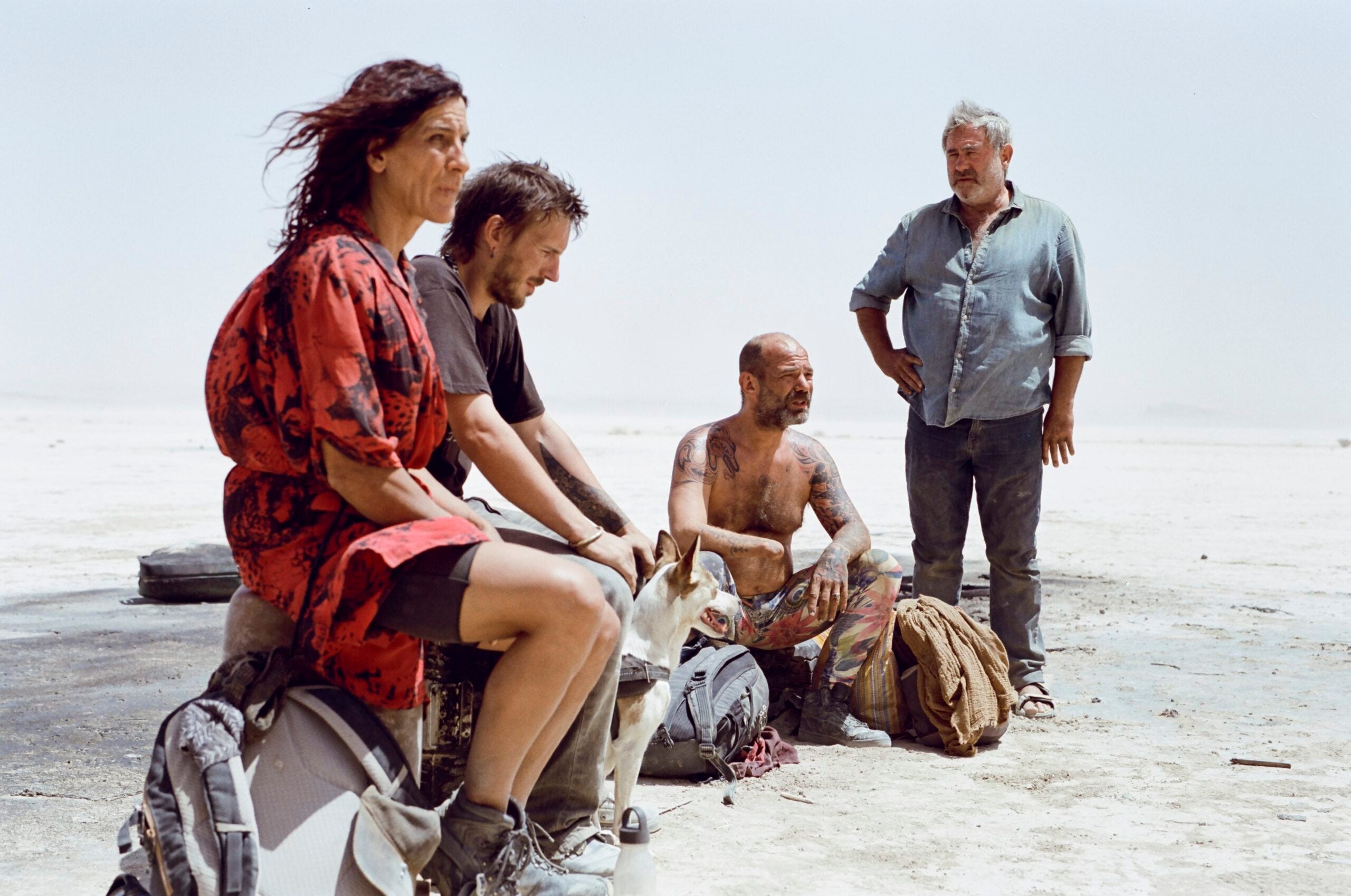
The RVs are occupied by group of tattoo covered, Kool-Aid-haired ravers who aren’t much younger than Luis. Bigui (Richard Bellamy) is missing an arm, Tonin (Tonin Janvier) is missing a leg, Josh (Joshua Liam Henderson) is a punk from England, Jade (Jade Oukid) is the only one under 30, Stef (Stefania Gadda) is the smartest person of the five and the unofficial leader.
These five are nomads who’ve abandoned conventional life in Europe to follow raves around the world. They are all hard partiers and do seem kind of intense on occasion, but none are bad people.
The kindness they show Luis and Esteban really surprised me. They let Luis know that it is incredibly unlikely that he’ll find Mar by following them, but they don’t stop him from following anyway. They share food, water and fuel with Luis and Esteban. They don’t try to ditch them. When Luis’s car breaks down, they don’t abandon the family.
It would all be quite moving if it didn’t go somewhere so horrifically tragic.
Sirāt has an incredible electronic music score by Kangding Ray. I knew that going into the movie which is why I expected it to be dreamlike and surreal.
The music is incredibly overwhelming at times. Enough to make you sympathize with the characters who’ve given up everything to dance in the wilderness2.
But Oliver Laxe and Santiago Fillol have written a story that deliberately stays linear and grounded. I am still not certain what they we were trying to say with Sirāt, but I have ideas, all of them pretty unsettling.
Much of the movie was filmed in Morocco and it features a scene on the notorious Mauritania Railway Iron Ore train, a three kilometre long cavalcade of open cars full of glittering, toxic, iron dust. Most times, it’s also full of hundreds or thousands of poor people who use the train as a free method of transportation through 700 kilometres of the Sahara desert between Morocco and Mauritania.
Lately the train is also full of travel bloggers and vloggers documenting the journey as a unique, fun, once-in-a-lifetime experience, which is exactly how it turns out for the characters in Sirāt, minus the fun part.
or three weekends, if you prefer to see it that way
Sirat has also been nominated for Best Sound and that is the Oscar it deserves to win!